
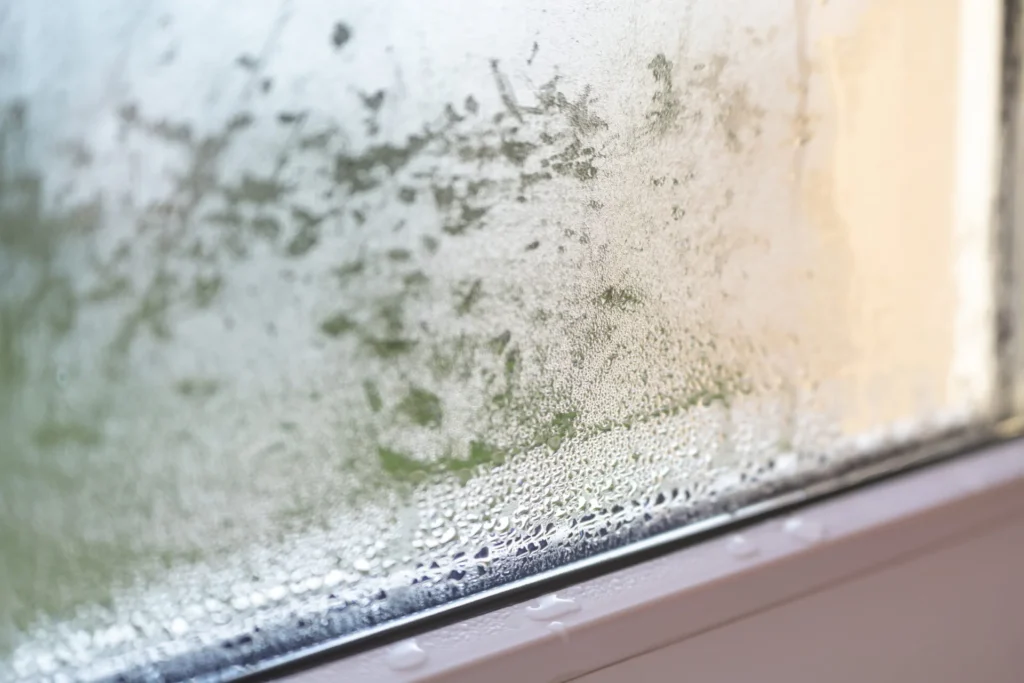
Most people notice condensation on their windows and think nothing of it. It’s just one of those things houses do in winter. You wipe it off, and it comes back the next morning. Eventually, you stop noticing it at all. It feels like a minor nuisance: cosmetic, seasonal, unremarkable.
But persistent condensation inside a home is not cosmetic, and it’s not something to normalise. It’s a signal. It is a visible, measurable sign that moisture is accumulating indoors faster than it’s escaping. The conditions for mould growth are either already present or steadily being created.
Recognising condensation as a warning shifts your viewpoint on its significance.
What Condensation Is Actually Measuring
Condensation occurs when warm, humid air comes into contact with a surface sufficiently cool to cause the moisture to condense into liquid water. This is the same process that fogs up a bathroom mirror or beads water on a cold glass. In homes, it happens on windows, walls, and structural surfaces.
The key is the amount of moisture in the indoor air. Low-humidity air can touch cool surfaces without causing condensation. High-humidity air can keep it on more surfaces for longer, even after the moisture source is gone.
This is why condensation is a useful diagnostic. If it appears consistently, on windows each morning, on walls in certain rooms, or on tiles long after using the bathroom, it signals high humidity. If you see it on surfaces, it’s likely also in wall cavities, behind built-in wardrobes, within insulation batts, and under roof structures. These hidden places let moisture sit undisturbed, so mould can grow without visible signs until the problem is advanced.
Wiping a window removes water but doesn’t reduce the underlying humidity.
Why Some Rooms Accumulate Moisture So Reliably
Condensation and dampness concentrate where moisture is generated most, airflow is most restricted, or temperature differences are greatest.
Bathrooms are the most obvious example. A single shower can quickly raise the humidity in a small, enclosed room. Without effective extraction that continues after the shower, that humidity has nowhere to go. It migrates into nearby rooms, collects in grout and silicone, and seeps into wall cavities through gaps in tiling and sealing.
Bedrooms are less obvious but important. A person sleeping in an enclosed room overnight exhales about a litre of moisture. In a shut room with no airflow, that moisture stays inside. By morning, humidity rises, explaining common window condensation, and mould often appears in bedrooms first.
Wardrobes on external walls have ideal conditions for condensation. The external wall stays cooler than the room air. This drives condensation on the inner wall, behind clothing, in an enclosed space with no airflow and no light. Mould can grow extensively before the smell is noticed when the wardrobe is opened.
Kitchens and laundries produce intense, brief bursts of steam. This can overwhelm extractor fans, especially if the fans are too small or if ducts vent into ceilings rather than outdoors. Many homes have this installation issue more often than expected. In each case, the common thread is not just the activity. It is a mix of moisture and insufficient airflow that prevents it from being removed before it settles.
The Musty Smell That Cleaning Never Fixes
A reliable sign of moisture issues is a persistent musty smell that cleaning can’t eliminate.
The smell comes from microbial volatile organic compounds that moulds release during growth. You can observe this even before visible mould appears. Mould inside a wall or under flooring releases these gases into the air long before becoming visible. Two factors make this easy to miss. First, the smell often develops gradually over weeks or months. There is no clear starting point. It becomes the home’s normal scent rather than a sudden change. Second, the brain filters out constant, familiar smells. People living with it daily stop registering it. Visitors notice it immediately.
If a room always smells damp or musty despite cleaning, and the smell returns soon after, the source is almost always biological and ongoing, not a lingering odour. Perfume products and cleaners only mask what you smell. They do not change the medium or stop mould growth.
Where Condensation Eventually Leads
The progression from condensation to mould is not immediate but is consistent. Repeated moisture on surfaces, especially porous ones such as plaster, timber, grout, and ceilings, can raise their moisture content over time. When materials retain enough moisture, mould can grow. Moisture, a surface, and low airflow create ideal conditions.
Mould in wall cavities, behind plasterboard, within insulation, or in subfloor and roof spaces cannot be removed using surface cleaning. It will keep growing. It releases ores and compounds into living spaces. It also damages materials, often for years, before the issue is noticed.
This is why window condensation, easy to ignore or wipe away, matters more than it seems. It shows indoor moisture is high enough to enter the building’s structure over time.
What Effective Ventilation Actually Does to This Problem
Ventilation breaks the condensation-mould cycle by reducing indoor humidity. When fresh, dry outdoor air is brought in and humid indoor air is removed, moisture from daily life does not accumulate. It gets diluted and leaves before reaching levels that cause condensation and dampness.
This is the difference between reacting to moisture problems and preventing them. Occasionally, opening windows or running a bathroom fan gives some relief. In tightly sealed modern homes, particularly in humid areas, this is often not enough to keep moisture low and stop recurring condensation and mould.
Purpose-built ventilation systems constantly manage airflow. In subfloor spaces where moisture rises and remains hidden, subfloor ventilation addresses this source directly. In roof spaces and enclosed areas, mechanical ventilation removes the stale, humid air that helps mould grow.
The aim is not just air that smells clean, though that is a quick result. The real goal is to keep indoor humidity low enough to prevent condensation from recurring and to prevent mould from getting the moisture it needs.
Acting Before the Problem Is Visible
By the time condensation, dampness, or mould is obvious, it’s been developing for some time.
Visible mould on a surface is not the start; it is when a moisture problem finally becomes clear. The earlier signs, condensation, musty odour, and lingering dampness, came first and were easier to fix.
Controlling humidity and airflow early is one of the most cost-effective ways to protect your property and health. Once mould spreads into building materials and structural spaces, remediation becomes much more costly. Fixing the problem then is restoration, not prevention.
Healthy homes need more than clean surfaces. They need indoor environments with moisture management. Condensation on a window ought to prompt investigation, not just a wipe. Airflow is a key function of the building, not a minor detail.
Concerned about condensation, humidity, or air quality in your home? Riteflo’s team will assess your property and recommend the right ventilation solution. Contact us today.
Want to learn more about the Mystery of Mould? Check out our CEO, Mirko Na, speaking with Norah Copithorne on the YouTube podcast.